The Episodic Pivot

Stockbee's Explosive Discovery and Qullamaggie's Blueprint to Millions
The MAGNA 53 Cap10*10 checklist and how Qualliscan can help identify them.
The Setup That Rewarded Tens of Millions
There's a moment in trading when a stock stops being a line on a chart and becomes something else entirely — a story that the market is just beginning to understand. That's the essence of an Episodic Pivot. And if you've followed Kristjan Kullamägi (Qullamaggie) for any length of time, you already know he owes a significant debt to one man for it: Pradeep Bonde, better known online as Stockbee, who coined the Episodic Pivot.
Pradeep is a veteran swing trader, educator, and the founder of the Stockbee community. He's been quietly developing his methodology for over two decades, largely away from the mainstream. But the traders who found him — Kristjan among them — went on to produce extraordinary results.
"I will take Episodic Pivots as an example in this post, a setup I learned from Pradeep Bonde (Stockbee), that has rewarded me several tens of millions in profits over the past couple of years alone." — Kristjan Kullamägi, qullamaggie.com
That's not a typo. Tens of millions. From a single setup that originated in a Stockbee blog post back in 2010. The concept has since been refined, expanded, and battle-tested through multiple market cycles. Today, we're going to break it down — from the foundational theory to the MAGNA 53 Cap10*10 checklist to where Qualliscan fits into your pre-market workflow.
What Exactly Is an Episodic Pivot?
The name comes from storytelling. In television, an "episodic pivot" is a dramatic twist — a moment that fundamentally changes the direction of the narrative. In trading, it means the same thing: an unexpected catalyst that forces the market to completely re-evaluate a stock's value and trajectory.
Pradeep borrowed this framing intentionally. Because what he observed was that certain stocks, often ignored for months or years, would experience a single event that changed everything. An earnings report that demolished expectations. A guidance raise no analyst saw coming. A product announcement that redefined the company's growth runway. And when that pivot happened, the stock didn't just move — it launched.
These aren't technical setups in the traditional sense. They're not about the shape of a base or the position of a moving average, though those factors matter for the entry. The Episodic Pivot is fundamentally a catalyst-driven event. The chart is just where you observe the evidence.
The Two Core EP Types
Pradeep identifies two flavors of genuine, real-catalyst EPs:
- Growth EPs: Companies already on a growth trajectory that release results so strong they catch the market off guard. Consecutive sales growth above 39% is Pradeep's key threshold — a level he identified from studying hundreds of historically explosive moves.
- Turnaround EPs: Neglected or beaten-down companies that deliver a surprise so large it forces a total reassessment. These often produce the biggest and most sustained moves precisely because the starting expectations are so low.
Additional EP Type
- Story/Thematic EPs: Do not require earnings or sales, just the hot theme or story in the market. These EP's tend to appear later in a bull markets that do not require earnings or sales.
Classic EP examples traders reference:
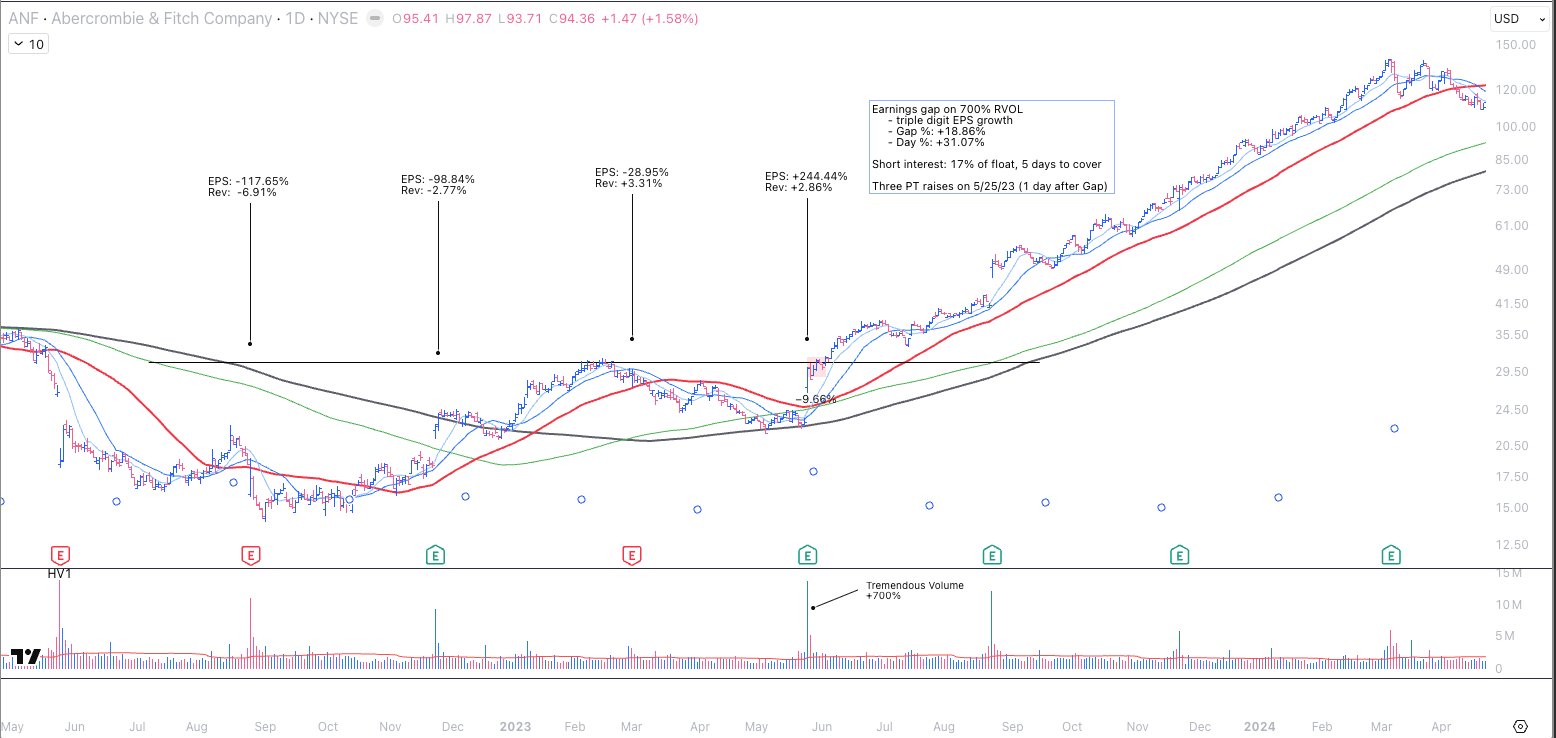
- ANF (Abercrombie & Fitch) in 2023, which went from a retailer no one cared about to a massive multi-month winner after a stunning earnings turnaround. The earnings gap was met with tremendous volume.
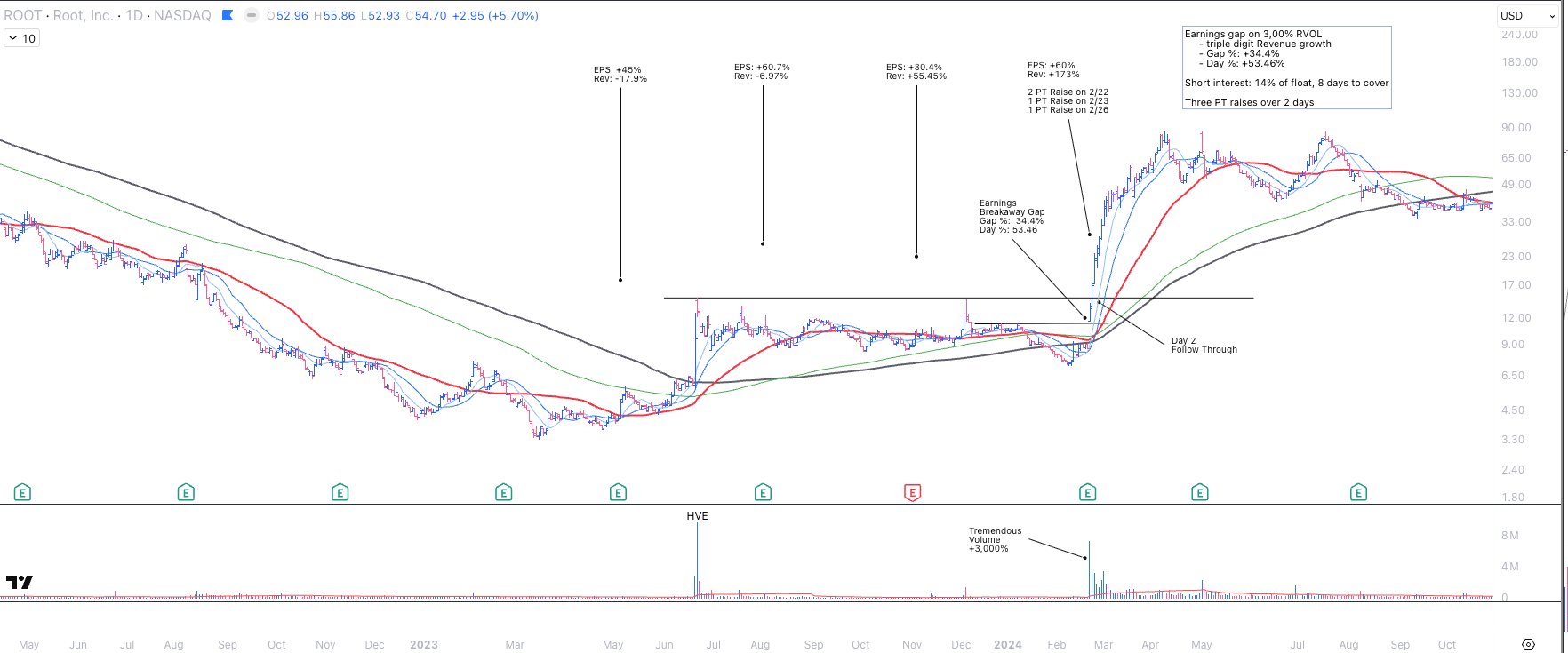
- ROOT in early 2024, a growth EP where Revenue growth was +173% and EPS, the second quarter of greater than 39% Revenue growth for the company. EPS growth was +60%. The Earnings gap was met with tremendous volume.
How Qullamaggie Adapted It
Kristjan took Pradeep's foundational framework and applied his own execution principles — particularly around intraday entry and position sizing. His definition is precise:
"My definition (this may differ from Pradeep's) is a gap up of 10% or more. There has to be massive volume near the open, ideally the stock should trade the average daily volume the first 15–20 minutes or even quicker." — Kristjan Kullamägi, qullamaggie.com
That volume threshold is critical. Kristjan isn't looking for any gap — he's looking for volume confirmation so overwhelming that it tells you institutional money is responding in real time. The gap is the news. The volume is the verdict.
His entry methodology is similarly precise. He often waits for the first one-minute candle to form, observes volume, then buys the break above the opening range high. He can add on the five-minute high for additional confirmation. The stop is always the low of the day. This isn't a casual approach — it's disciplined, rules-based execution layered on top of a fundamentally sound catalyst.
And crucially, Kristjan looks for the same qualitative factor Pradeep embedded in his original framework: neglect. Stocks that nobody was watching. No analyst coverage, minimal mutual fund ownership, months or years of flat price action. Because when a neglected stock delivers a genuine surprise, the market doesn't just react — it scrambles.
Breaking Down MAGNA 53 Cap10*10
Pradeep systematized his EP selection criteria into a checklist called MAGNA 53 + CAP 10×10 — often shortened to MAGNA 5310. Think of it as the fundamental filter that separates high-probability setups from random noise.
The framework has two layers: MAGNA criteria are required, the 5 and 3 add conviction, and the CAP 10×10 modifiers are optional but flag setups with the most explosive potential.
MA — Massive Acceleration Triple-digit earnings growth or a massive beat vs. analyst expectations. Example: analyst forecast $0.10 EPS, company reports $0.50. Or sales surging 100%, 200%+.
G — Gap Up The stock gaps up on the catalyst day — signaling the news was a genuine surprise to the market with strong early buying pressure.
N — Neglected The stock has been ignored for months or years: few mutual funds holding it, no analyst coverage, no significant news flow. The longer the neglect, the bigger the potential move.
A — Acceleration in Sales Real revenue growth — not earnings massaged by cost-cutting. Sales growth above 39% on consecutive earnings is Pradeep's key threshold. This number can't be faked.
5 — Short Interest: 5+ Days ⚡ Adds Conviction Short interest of 5 days to cover or more adds rocket fuel. As the stock moves up, shorts must cover — accelerating the move.
3 — Three or More Analyst Upgrades ⚡ Adds Conviction Three or more analysts raising price targets post-catalyst. Signals institutional re-rating is beginning — and more institutional money will follow. The news for analyst upgrades will typically appear throughout the day after the announcement.
CAP10 — Market Cap <$10B 🔧 Optional Amplifier Smaller companies move faster and further.
10IPO — IPO within 10 Years 🔧 Optional Amplifier Most explosive stock moves happen in the first decade of a company's public life. Younger companies with new growth stories have more room to run.
How to read MAGNA 53 Cap 10 * 10: The four MAGNA criteria are non-negotiable — if any are missing, the setup loses its edge. The "5" and "3" are strong conviction boosters; the more boxes checked, the higher the probability. CAP10 and 10IPO flag setups with the most explosive historical precedent. Pradeep's rule of thumb: MAGNA is the table stakes. 53 is the edge. CAP10×10 is the multiplier.
Why It Works: The PEAD Anomaly
Episodic Pivots aren't just pattern trading. They're grounded in a well-documented market inefficiency called PEAD — Post Earnings Announcement Drift. Ball and Brown first documented this phenomenon back in 1968, and it's held up across decades of research.
The core finding: stocks in the top decile by earnings surprise don't just pop on the announcement day — they continue to drift upward for weeks, sometimes months, afterward. The market systematically underreacts to truly unexpected positive news. By the time institutional money finishes repositioning and analysts finish revising estimates, the stock has often made its full multi-month move.
That's the trade. The catalyst creates the gap. The PEAD creates the runway. And the neglect factor turbos the whole thing — because when a stock that nobody owned suddenly gets fundamentally re-rated, the scramble to establish positions can become a multi-week or month tailwind.
Situational Awareness: The Filter Above the Filter
Here's what separates the traders who profit from this setup consistently from those who don't: they only press hard when conditions are right. Pradeep is explicit about this. The MAGNA checklist identifies the setup. Situational awareness determines whether you act on it.
In a strong confirmed uptrend, you trade aggressively. You build full positions, use Qualliscan's RS leaders as your universe, and set your stops at logical support areas on the chart based on your entry tactics. In a sideways, choppy or weakening market — you size down or stand aside.
Even the best individual setup will underperform in a hostile tape. Episodic Pivots work because they create a fundamental re-rating event — but a weak overall market can hold back genuine catalysts.
Use Qualliscan's Market Monitor module as the general market health check. When the top sectors are leading, when RS leaders are breaking out and holding, when new highs outnumber new lows, when the general market is holding and supported by their MA's — that's when you show up for EP season with full conviction.
You don't chase every gap. You wait for the genuine catalysts, the ones where the fundamental story has changed and the market is scrambling to catch up.
The MAGNA framework is really just a formal way of asking: is the story real? Is the company earning this re-rating, or is the market chasing headlines? Because the setups that produce 30%, 50%, 100% or more moves aren't random. They're backed by genuine business acceleration that most of the market missed — sometimes for years.
Putting It to Work: The Qualliscan Pre-Market Workflow
Using Qualliscan can help cut down the time spent finding and researching potential EP's. Scanning for Episodic Pivots requires pre-market and post-market discipline. As Pradeep puts it: "Night Time is Right Time, Morning Time is Right Time." You're building your watchlist before the open, not reacting to price after the fact.
Step 1: Evaluate Market Health
Open Qualliscan and visit the Market Monitor Module to evaluate the current state of the market. Without a constructive environment, even the best of EP's can be held down by the weight if the market.
Step 2: Identify and Research potential Episodic Pivots
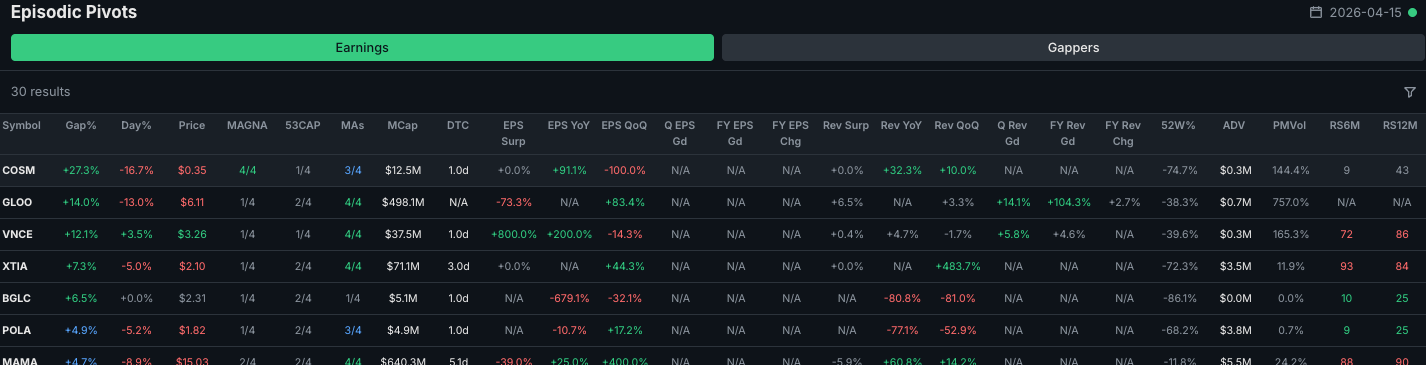
Qualliscan's Episodic Pivot Module has two section to identify and review potential EP's, the Earnings section and the Gappers section.
- Earnings Tab: Evaluate potential Earning EP's
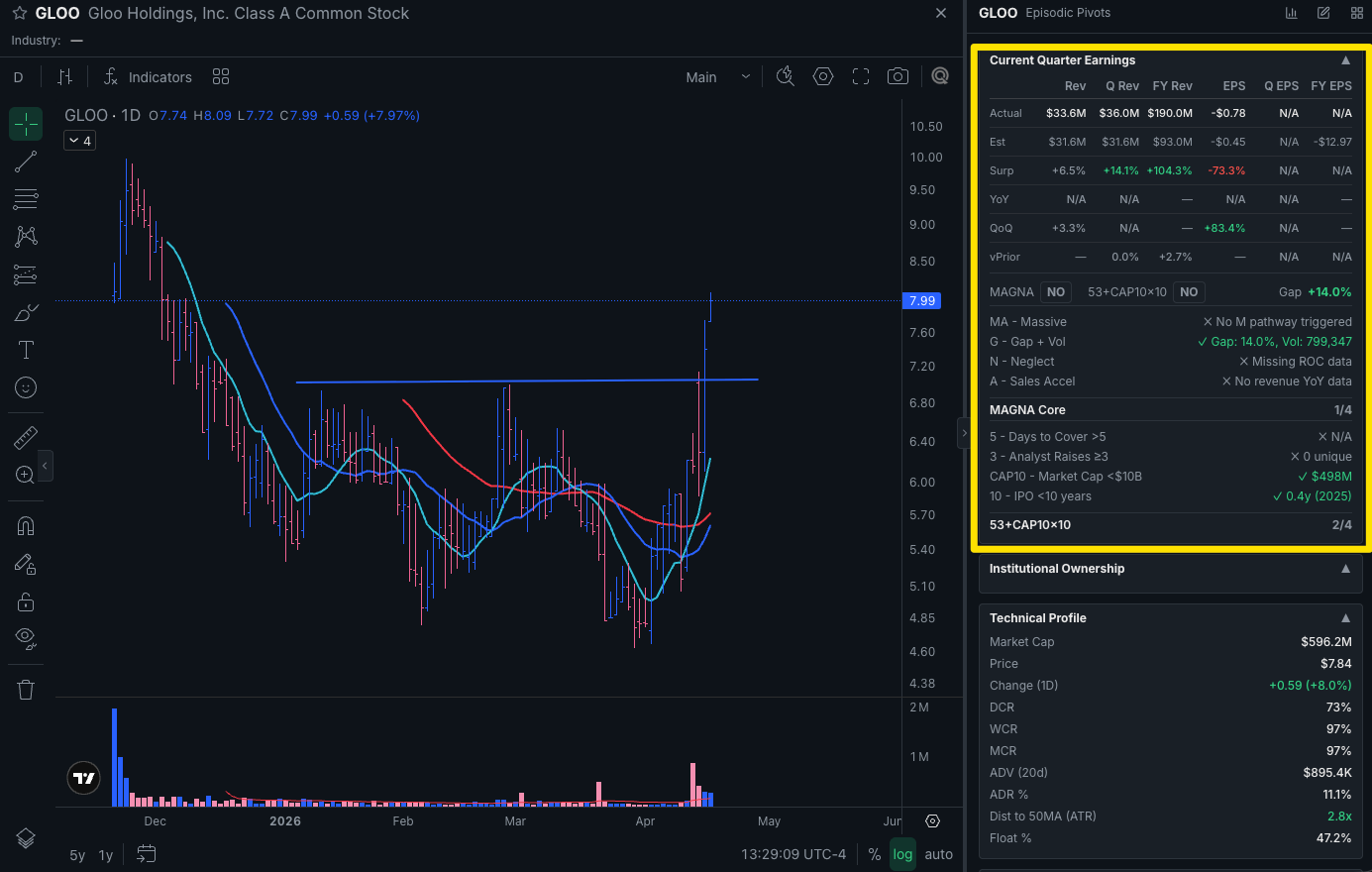
- The earnings tab summarizes the companies that have reported earnings from the prior days close. The Summary table provides a quick snapshot of how many of the MAGNA 53 Cap10*10 Checklist are present in the stock, the EPS and Sales details from the earnings report, the pre-market volumes and gap percent change.
- Click on a symbol to analyze the price chart and review detailed earnings and MAGNA 53 Cap10*10 details in the widgets bar.
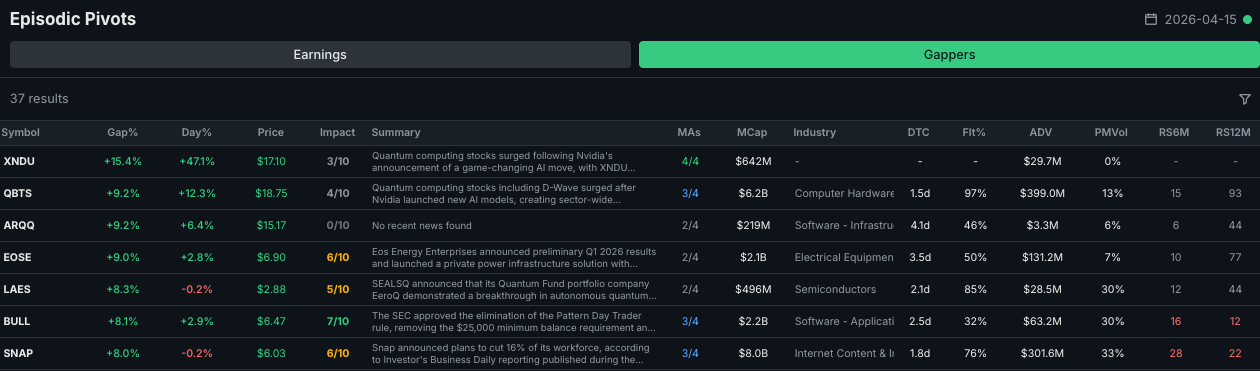
Gappers Tab: List of stocks gapping up more than 5% outside of regular trading hours at the time Qualliscan runs the analysis. A way to identify turnaround and thematic EP's.
- The summary table offers a quick glance of the Gap %, Price, and a one line summary of catalyst that may be causing the gap.
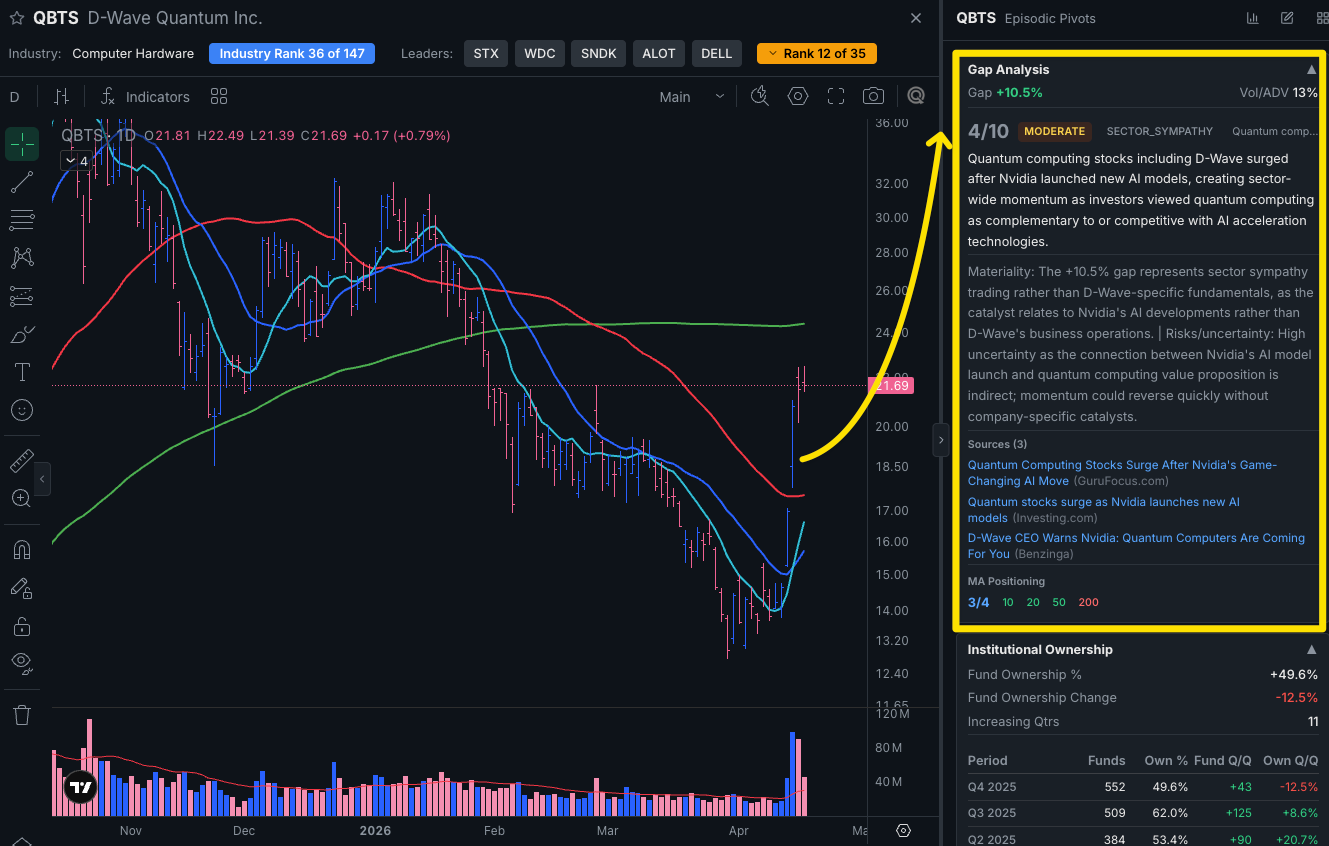
- Click on the symbol for a deeper dive into the price chart and Gap Analysis.
Step 3: Set Your Entry Parameters Before the Open
Once your focus list is set, define your entry rules before the market opens. Plan your trades and trade your plans. The trade plan should consist of entry tactic, initial stop loss and even a plan for selling into strength and trailing for when the trade is works in your favor.
Quick Reference: MAGNA 53 Cap10 * 10 Checklist
MAGNA
- MA: Triple-digit earnings and/or sales beat vs. expectations
- G: Stock is gapping 10%+ in pre-market
- N: Stock has been neglected — low fund ownership, long term price decline, low volume, no recent news
- A: Acceleration in sales (39%+ threshold), often 2 quarterly reports in a row.
53
- 5: Short interest 5+ days to cover (short squeeze fuel)
- 3: Three or more analysts raising price targets post-catalyst (can be released throughout the day or into the next day)
Cap 10 & 10
- CAP10: Market cap $10M–$10B range
- 10IPO: Company is within 10 years of its IPO
Qualliscan Workflow
- Market Monitor Module: Is the market healthy and conducive for EP's?
- Episodic Pivot Module: Research potential EP's
- Earnings tab - Identify Earning EP's
- Gappers tab - Identify Other EP types using
- Plan your trade, trade your plan.
This is analytical commentary, not investment advice. The content on this blog is for educational and informational purposes only and does not constitute financial, investment, or trading advice. I am not a registered investment advisor, broker-dealer, or financial planner. Trading and investing in securities involves substantial risk of loss and is not appropriate for every investor. Past performance is not indicative of future results. Always conduct your own due diligence and consult with a qualified financial professional before making any investment decisions.